
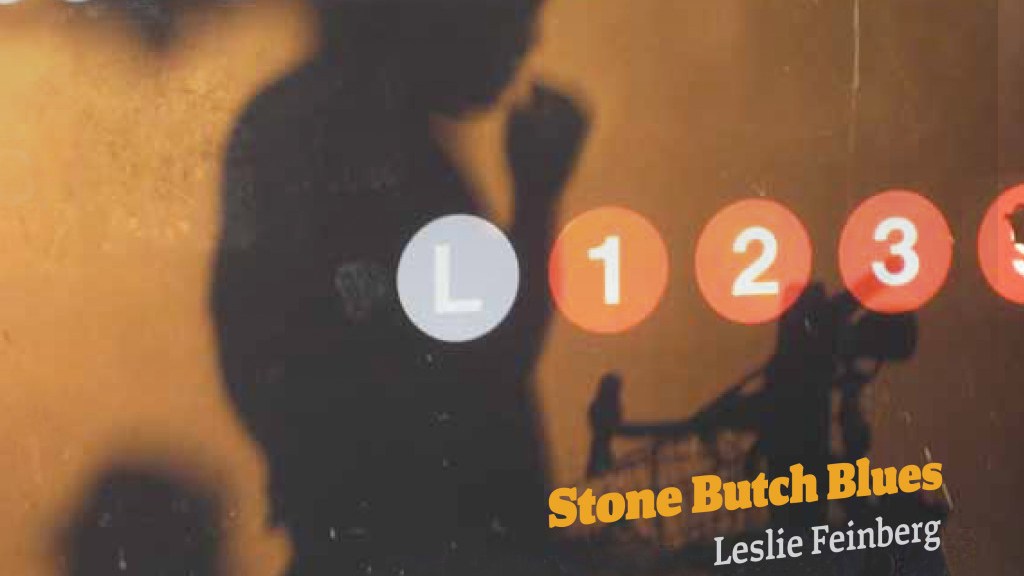
I finished Stone Butch Blues by Leslie Feinberg this morning and I’m going to have a lot to say about it, its themes, and its author over the coming weeks, months, and rest of my life. It’s essential queer reading for… everyone. Are you trying to work out your gender identity or sexuality? Do you want to hear more about how we were treated in the US throughout the latter half of the 20th century? Are you comfortably cis and/or straight but want to learn?
You can find it on Leslie Feinberg’s website for free.
In the latter half of Stone Butch Blues, the protagonist, Jess Goldberg, goes from merely surviving life to taking the time to learn about struggle. As she matured, and later through her relationship with Ruth, she started to read history and learned to appreciate music and art.
This line lit a fire in my brain:
“I’ve been going to the library, looking up our history. There’s a ton of it in anthropology books, a ton of it, Ruth. We weren’t always hated. Why didn’t we grow up knowing that?”
That’s a damn good fucking question, Jess.
I had to get out of my seat after typing that out because I felt all kinds of things I still need to parse. I feel seen, because I wonder this too. The seenness was soon followed by a fury that I touched on in my essay on the logic of transmisogyny:
“As such, transmisogyny should not be seen as inevitable. Transmisogyny is not normal nor natural. It is recent, it is Western, and it was violently foisted onto the rest of the world by the same colonial forces that separated people from land.”
This is not an accident, and Feinberg demonstrates this in Stone Butch Blues. It showed powerful solidarity between straight union men and the lesbians who worked in the factories alongside them. A memorable scene involved striking workers, including Jess, shouting at scabs crossing their picket line. A number of the men behind the picket line shouted a gay slur at the scabs, causing the butches to physically recoil from the line. The union leader, at Jess’s prompting, recognised the harm in this and shouted at the men not to say that.
What a powerful show of support! This occurred at the same time Jess had come under pressure due to lesbians not being allowed to attend union meetings. There was a very real possibility the union could have lost the support of the butches if they didn’t stick up for them, too. But solidarity prevailed. Unions are always more powerful when they have a variety of people backing them; that’s what makes them unions!
The book and the author have a strong intersectional theme. Jess is targeted for being gay, for presenting as a man, for being Jewish, for being part of her union. She struggles day to day because she is working class and money is tight. Feinberg explicitly called out in zir afterword that the people who oppress gay and trans people also oppress people on the basis of race, class, disability and more. Zhe talks about how they need to do this, as they would not be able to keep their wealth If they did not.
All the ruling propaganda about what is “natural” and “normal” is aimed at justifying the status quo. And [capitalism] is a mighty difficult economic and social system to rationalize and defend!
…
How could such a grossly unfair social reality continue?
It could not unless those of us who do the work that creates such sumptuous wealth were not kept pitted against each other.
Oppression is always intersectional. The fight against it must be, too.
There is no such thing as a single-issue struggle because we do not live single-issue lives.
– Audre Lorde, Learning From the 1960s
Soon, I’m going to get stuck into my copy of Transgender Warriors, read more about Feinberg’s life, and do more digging about our history in general.
If you have anything to recommend, please share it. It doesn’t have to be a specific thing, but if you reckon I might benefit from, say, looking at a particular person or period of history, let me know, and of course anything more specific is great. I’m particularly interested in Australian and genderfluid histories, but anything in the realm of queer will do.
 Musings From a Queer Environmentalist