
People talking about trauma making you stronger has always been demoralising to me.
Content warning: This article discusses child rape.
Being raped made me weaker. It made me angrier, meaner, and overrode my sense of self. It gave me fragility. I didn’t feel strong, and so whenever I heard I should be, I felt like a failure.
Recovering from trauma takes a lot of time and work.
It’s a long road.
Losing the Self
Amy Remeikis, in On Reckoning, talks about how there is a before and an after when you have been raped. She talks about how important it is for those in the after to prevent others from joining us here1. It’s a useful framework, but it gives me a weird feeling I can’t place, because I don’t remember the before.
I wonder, sometimes, who I would be in the absence of rape. At the same time, I don’t think it matters too much since I was so young, and so much of me was changing regardless. I was seven when a family friend, only five years older than myself, took an unnatural interest in me. There is no way of knowing who I would have been in the absence of rape, so there is no point in wondering about it.
…Right?
I’m not so sure that’s true.
Despite my young age and barely-developed sense of self, it was still there. I have had a clear set of values around fairness and justice since before I was able to articulate it.
There is something you see all the time in fictional narratives which I find infuriating. That is, when the villain goads the main character into doing something cruel and then says this is their true nature. They claim the protagonist was merely pretending to be kind the whole time.
This ignores the fact that, in their absence, the main character would not have been cruel. That the cruel action repulses them so much, it may make them physically ill.
This is how I feel about trauma’s effects on my brain.
My natural state is to be kind, forgiving, and empathetic to others who are the same; who mean well. When I encounter people who are cruel, it feels most natural for me to not give them any quarter or let them get away with any of their bullshit, the high road be damned. It feels right when I am acting in this way.
The effects of trauma have gotten in the way of this my whole life.
I can feel when an urge is contrary to who I am, when I am being unnecessarily mean to someone I like, or am letting a prick get away with some garbage. I have come to realise it literally makes me sick. Headaches appear or intensify; I get random soreness; I get cold sores; I chew on the inside of my cheek in my sleep; I am in a constant state of having a cold or some other malaise. The most visceral tell is the crawling inside my arms, as it springs to action and scrabbles for an escape route, pushing against my skin, rearranging my muscles.
What’s more intense is what it does to my mind.
Bones
I do not think in words. The colours and shapes that form my internal world are varied, bright and vibrant.
When the spectre rises, I’m flooded with darkness, which dampens everything else. The colours disappear; the shapes fold in on themselves and turn to nonsense or nothing. It becomes all consuming; the paranoia, the anger, the helplessness, the wrongness under my skin.
I didn’t used to notice this. It’s only through hard therapy over the past two years that I’ve been able to recognise this, and then to work on it. Now, I can tell when a thought or urge comes from a place that is not me.
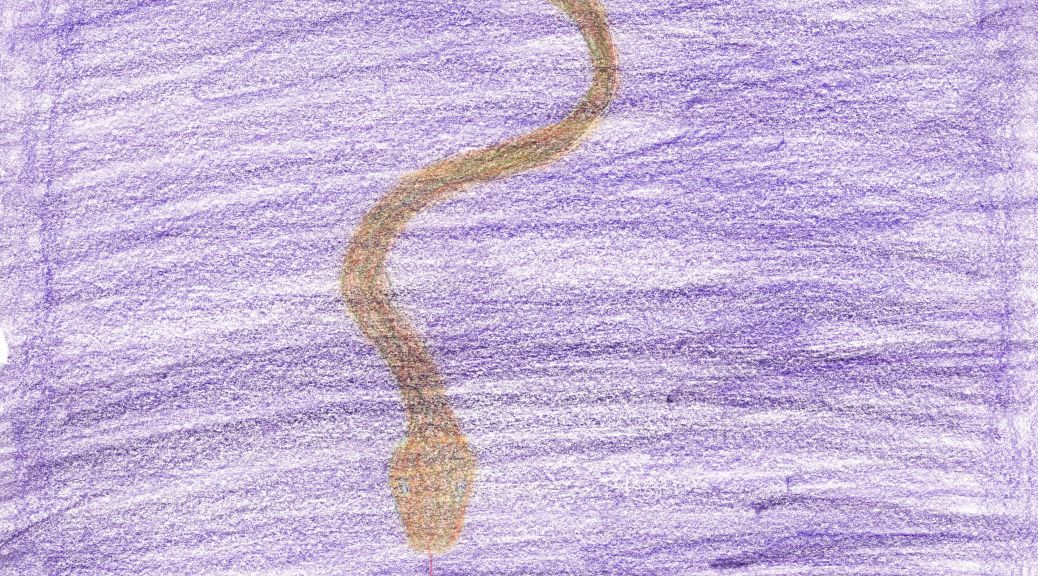
It slithers out from under my muscles, rising with the noxious purple smoke, and it will feel… wrong. I’ll crack it over something that doesn’t matter, or it will take a justified negative emotion and expand it until I am so apoplectic I can no longer form words. I shake, feel the urge to cry, lash out with hurtful words. It doesn’t feel apart of me; it is something else, something unwelcome, something toxic that exploded into my bones a long time ago and refused to leave.
And I get the crawling under my skin; the feeling that something is lurking, looking for a way out, scrabbling back and forth, trying to break free.
I don’t blame all negative emotions, thoughts, or urges on the trauma; that would be silly. I have negative reactions to things, I can be petty, sometimes I want to lash out when I’m upset. Sometimes I’m angry because someone is being a dickhead. Irritable because I’m hungry, tired, or overstimulated. Upset because something bad happened. That’s all totally fine so long as I don’t act on these feelings and hurt anyone else, and when I do, I front up and apologise. This is all part of the human experience.
That’s why I invoke the spectre of the purple funk; to differentiate my natural negative emotions from the ones manifesting as a trauma reaction.
The villain is at work, forcing me down to their level and then claiming I secretly want to be here.
I am me, and I am NOT you.
– Rufus Albarea, Trails into Reverie
I refuse to use the language of “my” abuser, “my” rapes, or “my” spectre. They are not me; they are not welcome here, and I don’t know how to articulate the feeling of repulsion when I think about describing them in that way. All of those were forced upon me, and I’ll be damned before I claim them and allow them to get comfortable.
Of course the spectre is going to be inserting its will into my thoughts, trying to pass them off as my own. Its survival depends on it.
Because once I started to see it, I started to work on it; to expel it.
Incision
For the past two years I’ve been excising the marrow of the invasion with the assistance of my psychologist, bit by bit, in our sessions. Digging it out, hacking deeper and deeper, toward the roots. I’m in up past my elbows, now, tearing and cutting and pulling to get the fucking thing out. I’m doing the hard work – no one else can do it, it has to be me – but there are people nearby, helping.
My psych parses tools with me, my friends are nearby keeping them sharp, passing me food and drink, telling me stories, adjusting my music – just being there so I can properly rest whenever I pull myself out of the muck and collapse onto the grass for a break.
It took – still takes – so much additional work for me to function at what is supposed to be normal. I have a vivid recollection of asking my psych if people without PTSD have to figure out all the shit we’ve been working on in our sessions; to work so hard to function at a baseline level. She told me that no, they don’t. I cried.
It is an unambiguously good thing that most people don’t have to deal with this. But fuck, it is so unfair that I – or anyone – has to deal with this bullshit.
It’s taken me years and thousands of dollars in therapy to get to my current point, in addition to all the support I’ve gotten from my extraordinarily broad support network. It’s still ongoing, and will be for the rest of my life, to some degree, but I am already having to do less, day by day.
Now, coming through to the other side, I am finally feeling strong. And rather than being belittling, talk of resilience now pisses me off.
We Need Material Support
Telling people who have been traumatised we need to be more resilient is bullshit. It literally changes the way our brains work, making it harder to do what we need to do. Sympathy without support is useless; politicians, who could choose to legislate proper, systemic assistance, can take their thoughts and prayers and shove it up their ass.
We need quality psychological care; a strong support network of people we care about where the feeling is mutual; we need our basic needs to be met.
All of this becomes easier to lose after a traumatic event. It’s harder to maintain relationships if you’re depressed, lethargic, irritable, angry, or otherwise upset.
From there, everything else breaks down. Friends and family in your support network might drop contact if they don’t want to be around someone who is regularly upset or unable to enjoy the things you used to do together. You can lose your job for similar reasons, or because you’re unable to continue performing at the level you were before. Suddenly, you can no longer meet your basic needs.
Then it becomes reinforcing. Can’t get better cause you don’t have the means, can’t get the means cause you haven’t gotten better.
I’ve gotten better for a few reasons:
- When I told Mum about the abuse, she believed me. My parents supported me. I was reassured it wasn’t my fault, and because I trusted my parents and the police, I have never had issues with guilt.
- I exercised agency. I’ve read a few books about trauma now, and a recurring theme is the loss of agency. The abuse ended because I told Mum; I had taken action. Without knowing it, I had reclaimed my autonomy, which would have repaired something in my brain.
- Strong support network. I had a lot of friends then, I had enough throughout high school. I somehow have so many more now, and the depth in my current relationships is nothing I’d have been able to fathom in the past. There are a lot of people I can lean on for a rant or a chat, about this bullshit or… anything else. There are people I can go see who are happy for me to sit there and be grumpy while they go about their day, so I don’t have to be alone, stew, and get worse. The foremost in my support network is, of course, my loving partner; we’ve been together for almost a decade and a half, now, and she is critical to my everything.
- Money. The cutie I started dating in high school turned out to come from a family that had money; she now has a well-paying job. It’s enough that I could not work for about six months and we’d still be comfortable. When I am working, we can easily afford specialist appointments, including therapy. This means I can get the psychological care I need, and I don’t have to worry about my basic needs.
Here is a non-exhaustive list of initiatives I want to see:
- We need a strong social safety net, so that people can drop out of work and not have to worry about food, rent, or bills. Or, even better, just make those things free so everyone can live.
- Psychological care (all medical care, really) should be free and fast. No one should have to wait weeks or months for anything, or be forced to choose between healthcare and food, housing, education, transport, or any other basic need.
- There need to be programs to support people who have been through traumatic events to find or rediscover community. That can be peer support programs, helping to reconnect with people they stopped talking with as they fell into the after, finding others with similar hobbies, work assistance, and more.
- The above should go hand-in-hand with campaigns to destigmatise abuse. All shame should be on abusers.
- Our legal system should actually help survivors of rape and sexual assault. I refuse to call it a “justice” system because it’s not. How many other crimes go to court to argue over whether they even happened? Very few, and those that do relate to people being abused by the powerful – people subjected to gendered, racial, heteronormative, ableist abuse have a hard time being believed or taken seriously.
- We need a society that is fundamentally different to what it is now. While we live in a society ruled by patriarchy, white supremacy, and colonialism, any solution will be temporary, always fought against by powerful politicians and their thinktanks.
A lack of resources should never be a barrier to anyone’s recovery, and every day policymakers choose not to act is a disgrace.
- Many don’t. In fact, many actually cut down other women who do, or who even talk about having been raped. I personally haven’t experienced this, so I am not well-placed to write an essay about it. Instead, check out this piece by Jo, who has been working as a rape survivor advocate for a decade. The racial dimension is not lost on me; I am of white descent, while Jo is of South Asian descent, and it’s overwhelmingly my fellow white women who are being an ass hole to her. ↩︎
 Musings From a Queer Environmentalist