
I learned recently that internal monologues are real. Up until a few months ago, I thought they were a joke invented by sitcoms.
I was unaware people actually have them, because I don’t, and it seems people who do have them are in the minority. In order to produce words, I have to really concentrate. They are not my natural mode of thoughts.
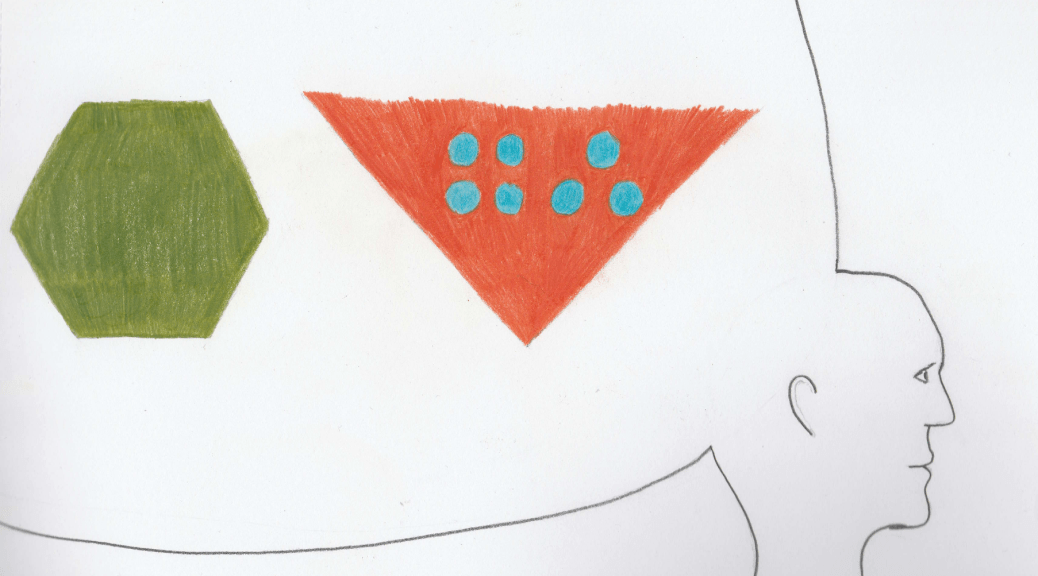
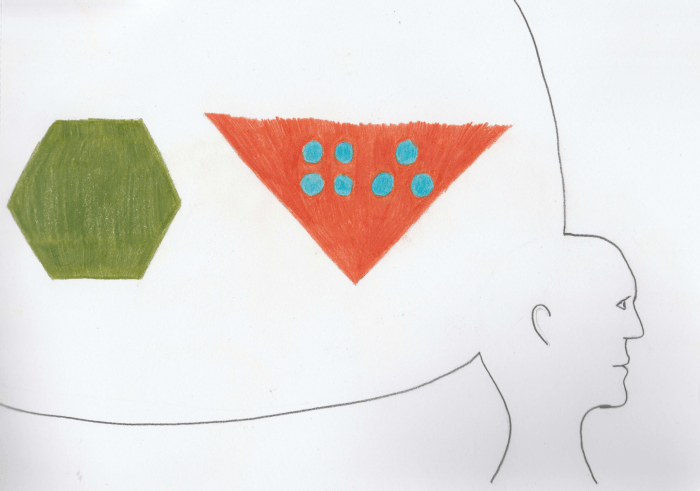
What I have instead are colours and shapes. When I’m listening to someone speak, or reading something, I’m not able to recall specific words particularly well. Instead, I remember the vibe of what was said; the coloured shapes in my mind that it was encoded on.
Sometimes it seems like I recall quotes well, but it’s less the words and more… the colours I associate with the concept of the quote. I might misspeak the exact wording if I haven’t gone out of my way to memorise it, but I’ll recall its relevance to me, as it’s embedded on the shape in my mind. And so sometimes things I say are a bit off, as it’s stored in my brain in such a way that my feelings about it are centred, and the other context around it comes later. Without additional information, the stuff that comes out of my mouth can seem totally out of pocket.
For the detail, I most strongly recall the cadence of the quote. I’ll be filling in the blanks in a way that make sense based on context, syllables per word, and intonation. I may miss the mark due to any of those things; replace a two-syllable falling intonation word with another that makes some sense, but misses the nuance.
As a result, sometimes when I’m speaking, I have long pauses as I try to reach for the appropriate word. People will often ask if I’m okay as they think something is wrong, to which I may reply that I’m tired, because how do I explain to someone that I don’t know what the green hexagon is trying to tell me?
Synesthesia
I also have synesthesia. I attach colours to numbers and letters. Interestingly, the colours for each letter or number can change when in combination.
A 6 on its own is a beautiful sky blue. But for 66, one of them is a dark purple, and the other a paler shade. I struggle to describe exactly which colour is used for each number or letter because of this; they’re always changing. And it feels like when I try to think about it, it gets harder to see, so I can’t describe exactly which colours correspond to which numbers or letters when asked. I think it helps me be excellent at mental maths and number recall; even if I don’t consciously remember the colours, my subconscious does.
I started paying attention to the synesthesia because it was giving me issues in Final Fantasy XIV. I was tackling a difficult fight with seven friends, and at one point, players have a number of dots appear above each of our heads. We get between one and eight dots, indicating the order in which we were about to get exploded and needed to move away from the group so no one else got caught in the crossfire. Even numbers were coloured red, and odd numbers were coloured blue. I kept dying when I was allocated seven, and it took me a while to realise why: The odd-numbered shade of blue was almost exactly the same shade of blue I associate with six. Because seven is so close to six and displayed almost exactly the same way, my brain automatically processed my seven as a six. So I’d move too early, get hit by the explosion before mine and then my own, and die.
It’s been useful and frustrating to learn that so many other people think in words. In order to express my emotions — before that, even — for me to even work them out for myself, I have to concentrate and make an effort and write it out.
I’ve been working with my psych to figure out my signs of stress, and have become more attuned to my body and my feelings in the process. I’ve been journalling for over a year, which has helped me to figure out what particular bodily sensations mean, when I should rest, need to engage my brain, or to create something with a pen or sketchbook. I’m still refining this, but I’ve come a long way in the last year and a half. It’s been a fantastic process, as I am now able to recognise my emotions when they’re small and work through them in a healthy ways.
Alexithymia
Last year I realised I had alexithymia. This is a condition by which people do not feel, recognise, express, or have the ability to describe their emotions. I am much better at it now, as described in the last few paragraphs.
I wonder… How much of the alexithymia is a mismatch between my natural mode of thought and what society uses?
If society communicated using shapes or pictures, would I have alexithymia? Would people with internal monologues, instead, be the ones with alexithymia?
I couldn’t find any research on this. If you know of any, send them my way. I’d love to see studies on alexithymia prevalence in people with different modes of thought in word-based vs. picture-based communication.
What about you, dear reader? How do you form thoughts?
 Musings From a Queer Environmentalist
Omg I also have synesthesia, and my number 6 is also blue!! Maybe a bit more cobalt rather than sky blue, and my two digit numbers are the colour of the first digit (so 66 is also cobalt, but 26 is dark forest green because that’s the colour of number 2). More than three digits and it gets wayyyyy harder to pin down. Such an interesting read!
I’m so glad you left a comment because I always feel weird being like “Yeah I have synesthesia but I can’t pin down the colours.” Almost like people would think I’m faking it?
Glad you enjoyed the article!!
I have a pretty mild form of Tourette’s. It doesn’t manifest itself as swears, but usually audible annoying exhalation from my nose, or a twitch of my eyes. I have trouble describing it, but sometimes it feels like I have a phantom limb extending beyond my head….sort of like horns…Hate saying that but its probably the best descriptor. Being neurodivergent is all I really know